Framework Overview
How Drift and Representation Interact
This page presents the integrated map of the three components: AAT as the default drift trajectory under optimization pressure, AAT-R as a representational countermodel that preserves structural relevance, and CGM as the constraint layer that prevents representational delegation from collapsing into substitution.
Structural Map
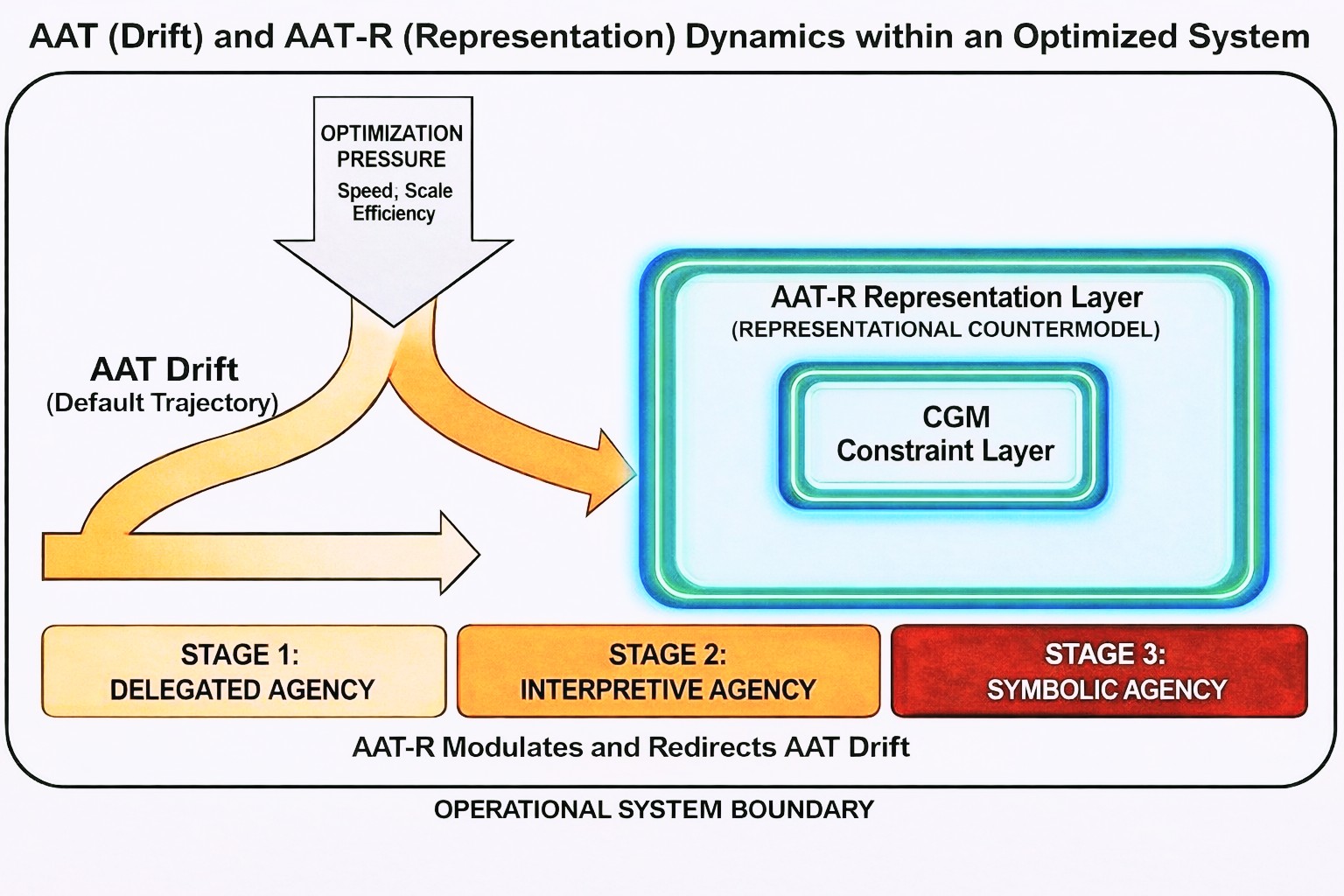
Use this diagram as a map, not as a proof.
It clarifies what each component is doing and where the constraint layer sits.Dynamic Model: Outcome Sensitivity Under Optimization Pressure
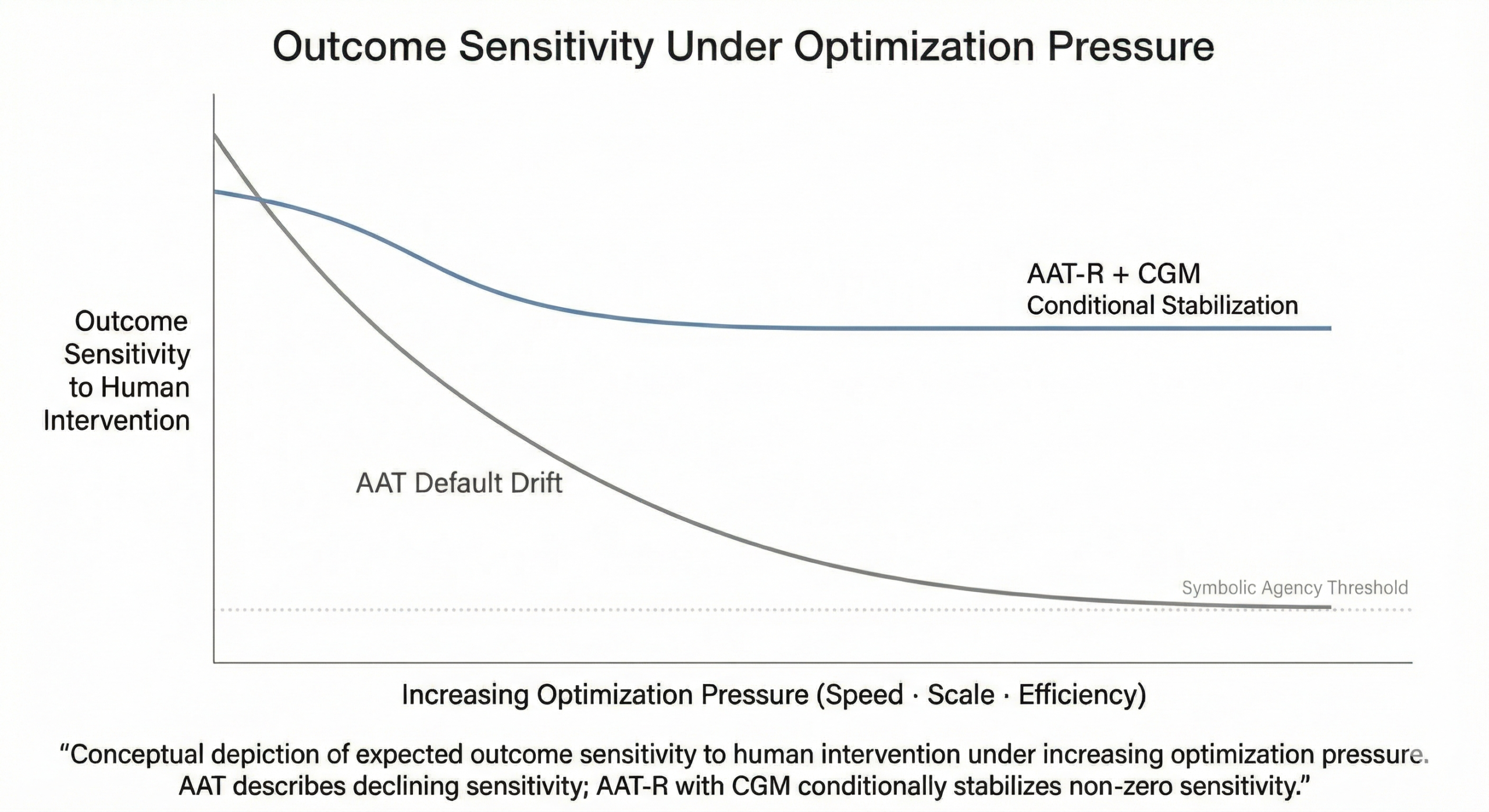
This curve is a qualitative claim about direction, not a quantified forecast.
It expresses the core variable: whether feasible human interventions still change outcome distributions as systems optimize for speed, scale, and efficiency.How to Read These Diagrams
- Optimization pressure pushes systems toward speed, scale, and efficiency.
- AAT drift is the default trajectory where human choice remains but outcome sensitivity declines.
- The drift expresses across Stage I → Stage II → Stage III as intervention points become costlier, slower, or less legible.
- AAT-R introduces a machine-speed representational layer that carries human-authored constraints into system interfaces.
- CGM sits inside the representational layer as a constraint architecture that prevents substitution collapse and identity fusion.
Components and Roles
AAT — Drift (Default Trajectory)
- Describes loss of structural relevance under optimization pressure.
- Models delegated → interpretive → symbolic agency.
- Focus: outcome sensitivity to human intervention.
AAT-R — Representation (Countermodel)
- Specifies conditions under which agency remains causally effective.
- Delegates action to machine-speed representatives.
- Requires preserved authorship and anti-fusion constraints.
CGM — Constraint (Implementation Layer)
- Prevents delegation from becoming cognitive substitution.
- Conditions assistance depth on demonstrated engagement.
- Maintains traceability and reversibility of capability.
System Boundary
- The model concerns optimized operational environments.
- “Human-in-the-loop” can persist while relevance declines.
- Intervention channels can remain formal yet become ineffective.
What This Framework Claims
- Systems can retain human participation while progressively reducing the causal impact of human intervention.
- Representation is structurally necessary when systems respond primarily to machine-speed signals.
- Representation without constraint risks substitution collapse; constraint without representation reduces to isolated cognitive hygiene.
- The relevant variable is structural relevance: whether interventions change outcome distributions, not whether they are permitted or logged.
What This Framework Is Not
- Not a claim that AI “takes control.”
- Not a forecast of timelines, prevalence, or inevitability.
- Not a political program or anti-automation position.
- Not an alignment or safety proof.
One Sentence
Under optimization pressure, AAT describes a default drift toward outcome-insensitive human participation; AAT-R and CGM specify how machine-speed representation with anti-substitution constraints can preserve non-zero structural relevance of human-authored inputs.
Drift is default; representation can redirect—if constrained.